.svg)

Generative AI did not make marketing easy, it made volume cheap. That is a double-edged gift. The teams that win are not the ones publishing the most AI content; they are the ones using AI to remove the bottleneck between a good idea and a finished, on-brand asset. This playbook shows lean marketing teams how to do exactly that.
Key Takeaways
- Compress idea to asset: use generative AI to remove the gap between a good idea and a finished, on-brand piece, not to flood channels.
- Repurpose first: the highest-leverage move is turning one strong asset into ten channel-native variants automatically.
- Protect the brand voice: feed the model your best examples, review every public-facing asset, and measure outcomes, not output volume.
Where Generative AI Fits in Marketing
Generative AI is best understood as a production accelerator. It does not replace strategy, positioning, or taste, it removes the manual effort between those decisions and a shipped asset. A marketer still decides the angle, the audience, and the offer. AI handles the first draft, the five variations, and the reformatting.
The mistake teams make is pointing it at the wrong layer. Asking AI "what should our campaign be?" produces bland strategy. Asking it "turn this campaign brief into five LinkedIn hooks, an email, and three ad variations in our voice" produces useful output, fast.
Building a Content Engine, Not a Gimmick
A content engine is a repeatable system: an input, a process, and an output that runs every week without reinventing the wheel.
Start From a Source of Truth
The best AI content is not generated from nothing, it is distilled from something real: a customer call, a founder's point of view, a product update, a piece of original data. Feed that raw material in and the output has substance. Generate from a blank prompt and you get filler.
Standardise the Brief
Create one reusable brief format, audience, angle, key message, call to action, voice notes, and you will get consistent results every time instead of re-explaining your brand on every prompt.
Repurposing One Idea Across Every Channel
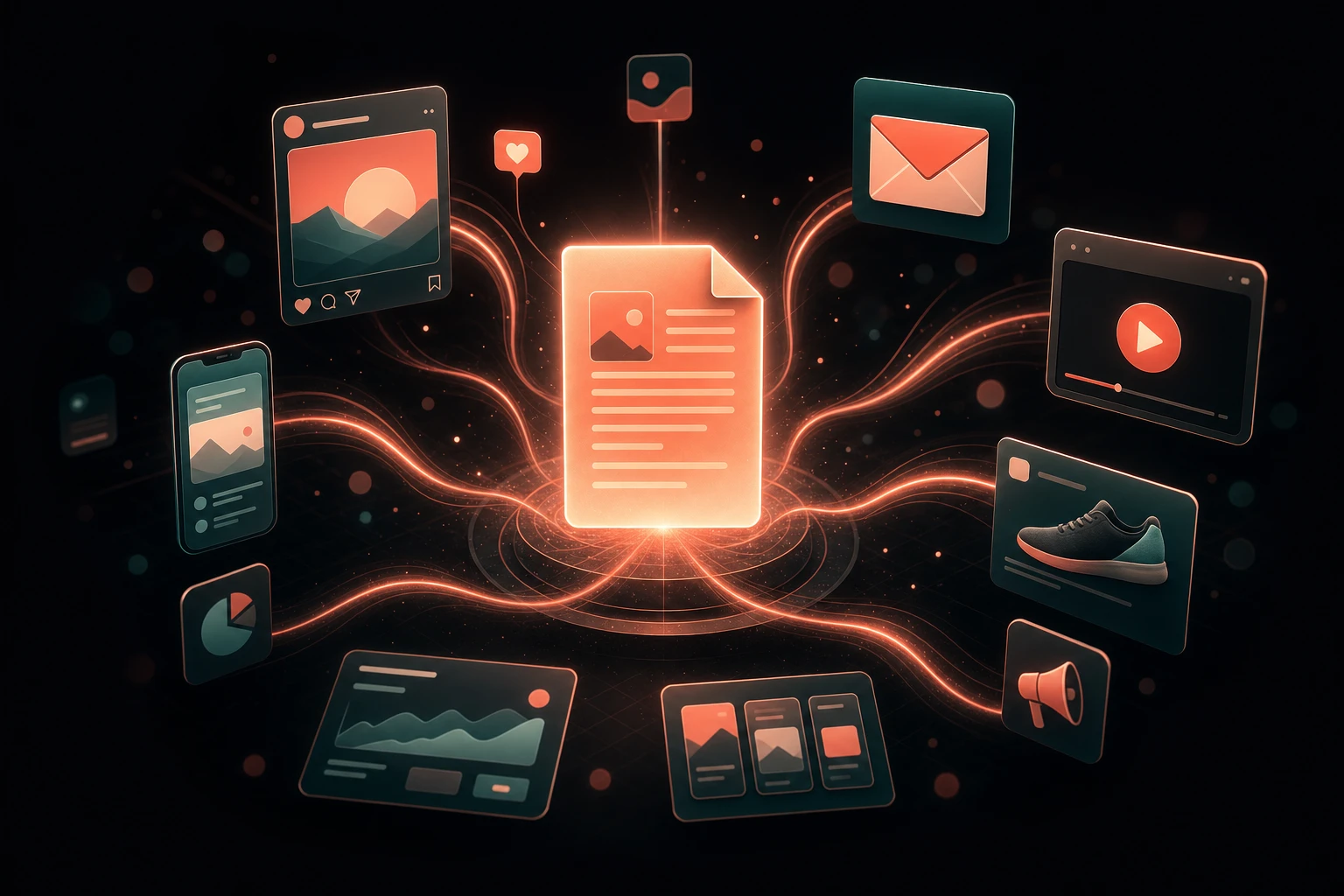
This is where generative AI delivers the clearest return. A single webinar, blog post, or customer story can become a week of channel-native content in minutes instead of days.
- → Long-form to short-form: turn a blog post into a LinkedIn carousel, a thread, and three standalone hooks.
- → Spoken to written: convert a podcast or call transcript into a newsletter and a set of quote graphics captions.
- → One message, many formats: reshape a product announcement into an email, an ad, and a landing-page section.
- → Evergreen refresh: update last year's top post with a current angle instead of writing from scratch.
Done manually, repurposing is the task everyone agrees they should do and no one has time for. Automated, it becomes the default. This is the same principle behind a workflow-driven approach to revenue content.
"The marketers getting real leverage from AI are not creating more. They are creating once and distributing ten times, with each version actually fitting the channel it lands on."
Common pattern across content repurposing workflows

Personalisation at Scale
Personalisation has always been a tradeoff between relevance and effort. Generative AI collapses that tradeoff. You can take one core message and adapt it to industry, role, company size, or funnel stage without writing each version by hand.
Segment-Aware Copy
Feed the model your segments and ask it to rewrite the same value proposition for each, a founder cares about time, a finance lead cares about cost, an operator cares about reliability. Same product, three framings.
Dynamic Outreach
For outbound, AI can personalise the opening line of an email from a prospect's profile or company while keeping the body consistent, relevance at the top, efficiency underneath.
Measuring What Actually Works
It is easy to celebrate output, "we published thirty posts this month." That is a vanity metric. Tie AI-assisted content back to the outcomes that matter.
- → Engagement quality: are the right people responding, not just more people seeing it?
- → Pipeline contribution: is AI-assisted content sourcing or influencing real opportunities?
- → Time reclaimed: how many hours moved from production back to strategy and customer conversations?
Frequently Asked Questions
Will AI-generated content hurt my SEO or brand?
Not if it is genuinely useful and reviewed by a human. Search engines reward helpful, original content regardless of how it was produced. Thin, unedited AI content is what gets penalised, and what damages a brand.
How do I stop everything sounding the same?
Always generate from real source material, always supply a voice file of your best work, and always have a human edit. Generic input produces generic output.
Do I still need writers?
Yes, but their role shifts from producing first drafts to setting direction, editing, and adding the judgement and originality AI cannot. The best teams use AI to give their writers leverage, not to replace them.