.svg)

When founders try to automate startup operations, most start in the wrong place and end up with a patchwork of disconnected tools that create more overhead than they solve. The real opportunity is not just replacing individual manual tasks but redesigning workflows so the business can scale output without scaling headcount at the same rate. This guide gives you a practical framework to identify what to automate first, how to implement it, and how to measure whether it is actually working.
Key Takeaways
- Start with the highest-volume, most repetitive processes first. Financial reporting, lead qualification, and email workflows typically deliver the fastest ROI.
- Tool selection matters less than process design. Define the workflow before choosing software.
- Integration complexity is the most underestimated challenge in startup automation. Map your data flows before committing to a stack.
- Automation ROI should be measured across three dimensions: time saved, error reduction, and team capacity freed for higher-value work.
- A phased implementation approach reduces risk and builds team confidence compared to a full system rollout.
Why Automate Startup Operations?
Early-stage startups operate under a structural constraint: the volume of operational work grows linearly with customers and revenue, but the team size cannot. Founders and operators spend a disproportionate share of their time on tasks that are necessary but not differentiating. Automation breaks that relationship between volume and labour, which is why it sits at the centre of any credible scaling strategy.
Time Savings for Lean Teams
A five-person startup handling fifty customers manually is already stretched. At five hundred customers, the same manual processes become existentially dangerous. Automating recurring tasks such as data entry, report generation, and follow-up sequences returns hours to the team every week, hours that can be redirected toward product development, sales, and customer success.
Cost Reduction and Resource Efficiency
The cost argument for automation is not just about avoiding new hires. It is about reducing the error-correction overhead that comes with manual processes. A misrouted invoice, a missed follow-up, or a data entry mistake each carries a real cost in time, customer trust, and sometimes money. Automation reduces the frequency and severity of those errors.
Scaling Without Proportional Headcount Growth
The goal for most founders is not to eliminate jobs but to raise the ceiling on what each person can handle. When your CRM automatically qualifies and segments incoming leads, your sales team can focus on closing rather than sorting. When invoices are generated and sent automatically, your finance function scales without adding an accounts payable specialist.
"The companies that scale most efficiently are not the ones with the most automation tools. They are the ones that automated the right processes at the right stage of growth."
— Common pattern in AI workflow automation implementations across early-stage B2B startups
Key Startup Operations to Automate First
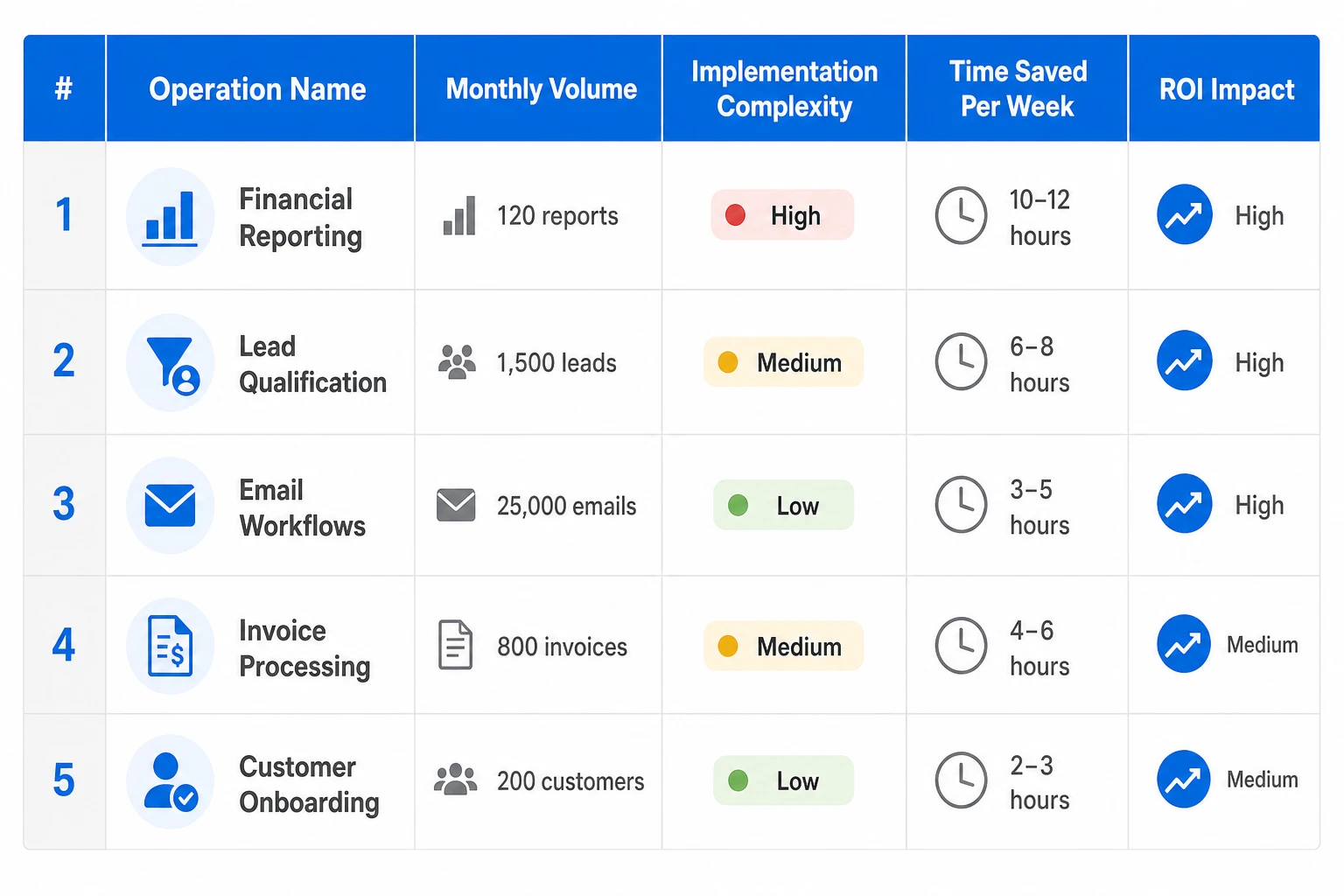
Not every process is worth automating immediately. The best candidates are high-frequency, rule-based, and currently consuming significant manual effort. Here are the six areas that consistently deliver the strongest early returns.
- ✅ Financial Reporting and Accounting: Automated reconciliation, expense categorisation, and report generation reduce month-end close time and improve accuracy without additional finance headcount.
- ✅ Customer Relationship Management: Automating contact updates, deal stage progressions, and activity logging keeps your CRM accurate without relying on manual input from sales reps.
- ✅ Email and Communication Workflows: Triggered email sequences for onboarding, re-engagement, and support responses ensure consistent communication at every stage of the customer lifecycle.
- ✅ Invoice and Payment Processing: Automated invoice generation, payment reminders, and reconciliation reduce late payments and the manual effort associated with accounts receivable.
- ✅ Data Entry and Record Management: Connecting your forms, spreadsheets, and databases with automation eliminates duplicate entry and ensures a single source of truth across systems.
- ✅ Lead Qualification and Outreach: Scoring and routing incoming leads automatically based on firmographic or behavioural criteria allows your sales team to prioritise effort toward the highest-value prospects.
Tools and Platforms for Startup Automation
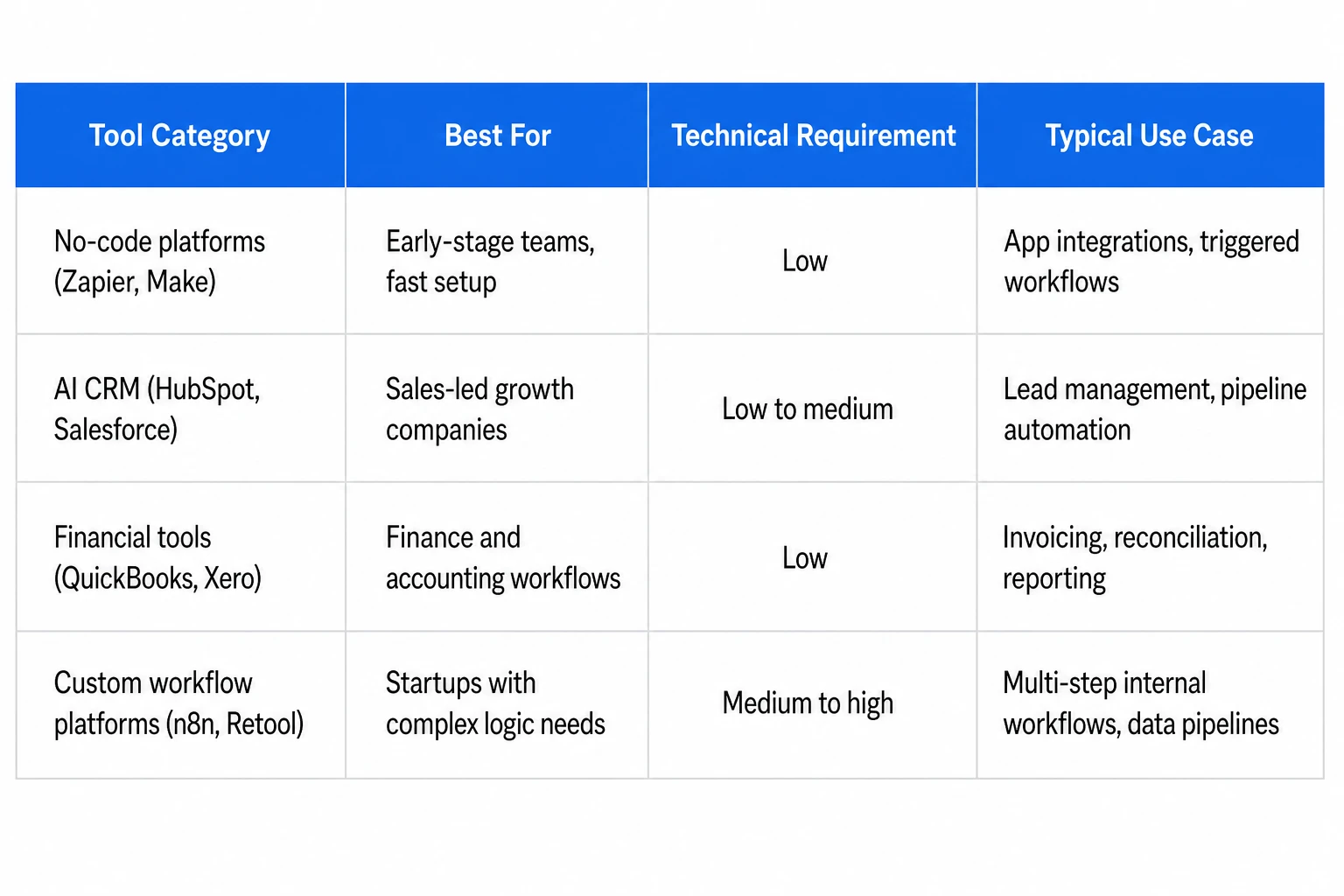
The market for automation tooling is broad. The right choice depends on your technical capacity, existing stack, and the specific processes you are targeting. Here is a category-level overview of the main options.
No-Code Automation Platforms
Platforms such as Zapier and Make (formerly Integromat) allow non-technical team members to connect applications and build automated workflows without writing code. They are well suited to startups in early stages where engineering bandwidth is limited. Visit the official websites for current pricing, as plans vary significantly based on task volume and feature requirements.
AI-Powered CRM Systems
Modern CRM platforms increasingly embed AI to automate lead scoring, email drafting, and pipeline forecasting. HubSpot and Salesforce both offer automation features within their CRM products. The right choice depends on your deal volume, team size, and integration requirements.
Financial Automation Software
Tools in this category handle invoicing, expense management, and financial reporting. Platforms such as QuickBooks and Xero offer automation features for recurring transactions and report generation. For more advanced accounts payable automation, dedicated platforms exist that integrate with these accounting systems.
Workflow Management and Integration Platforms
For startups with more complex operational needs, platforms such as n8n (self-hosted) or Retool allow custom workflow automation with greater flexibility than consumer no-code tools. These require more technical setup but offer significantly more control over data handling and logic.
Step-by-Step Implementation Strategy
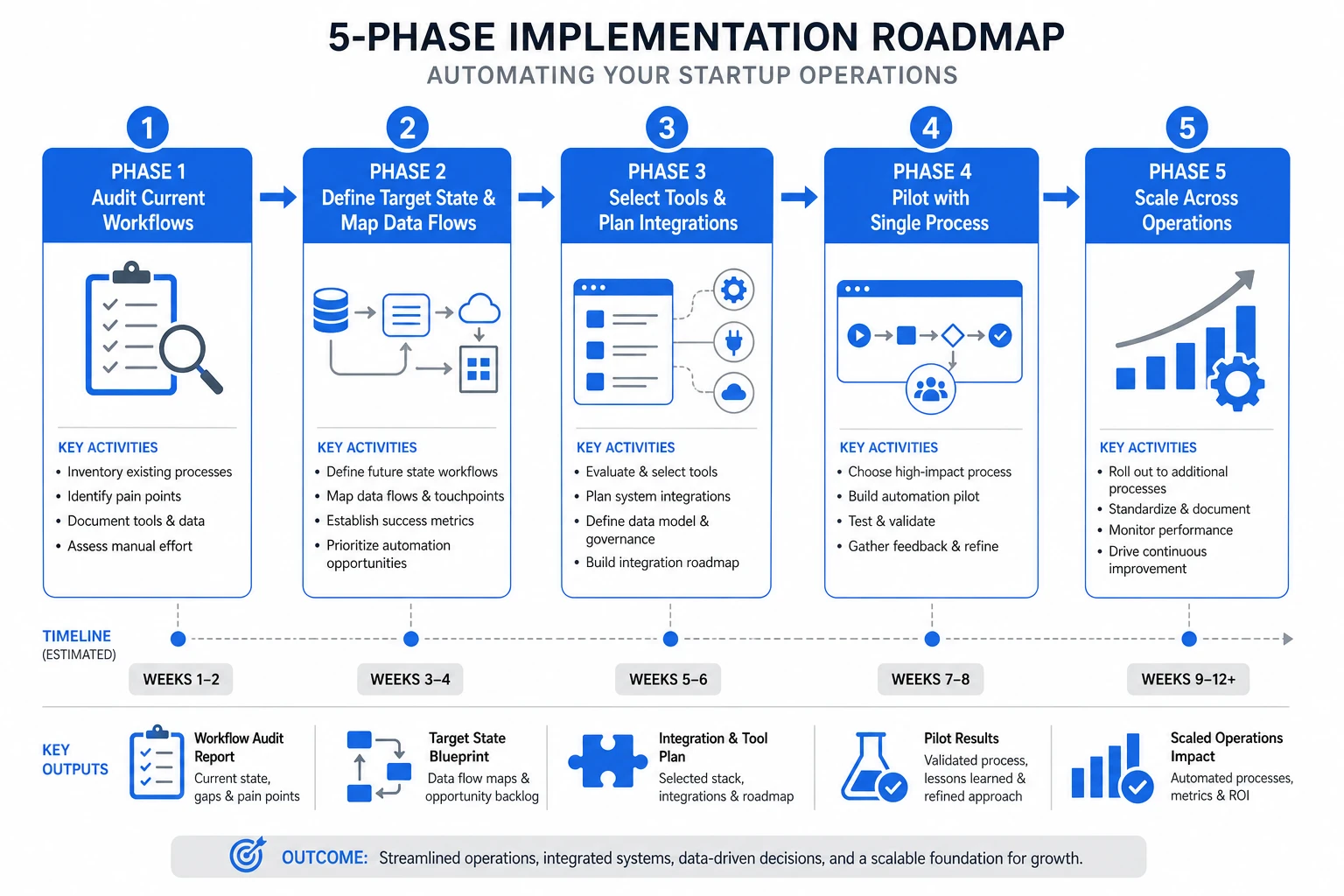
Successful automation is a project management challenge as much as a technology challenge. Following a structured implementation process reduces the risk of costly mistakes and ensures your team actually adopts the new workflows.
Step 1: Audit Current Manual Processes
List every recurring operational task your team performs. For each one, record the time it takes per week, the number of people involved, and the error rate. This creates an objective basis for prioritisation rather than relying on gut instinct about what seems most painful.
Step 2: Prioritise High-Impact Operations
Score each process on two dimensions: the time it currently consumes and the feasibility of automating it with your current tools and technical capacity. Focus your first automation sprint on the top-right quadrant: high time cost, high feasibility.
Step 3: Select Appropriate Tools
Based on your prioritised list, identify the specific tools that address your highest-impact processes. Where possible, choose platforms that integrate natively with your existing stack to reduce the complexity of data synchronisation.
Step 4: Configure and Test Automation
Build your automation in a test environment before deploying to production. Run it against real historical data to verify that outputs match expected results. Pay particular attention to edge cases, the unusual inputs that break rule-based logic.
Step 5: Train Your Team
Automation only delivers value if your team trusts it and uses it correctly. Provide clear documentation of what each automation does, what triggers it, and what to do when something goes wrong. Designate an internal owner for each critical workflow.
Step 6: Monitor and Optimise
Set up monitoring for your key automations so you receive alerts when workflows fail or produce unexpected outputs. Schedule a monthly review to assess performance metrics and identify new optimisation opportunities.
Common Challenges and Solutions
Even well-planned automation projects encounter obstacles. Understanding the most common ones in advance allows you to address them proactively rather than reactively.
- ⚠️ Integration Complexity: Many tools do not connect natively, requiring middleware or custom API work. Solution: map your data flows before selecting tools and prioritise platforms with native integrations to your core stack.
- ⚠️ Data Quality Concerns: Automation amplifies data quality problems. If your CRM has inconsistent field formats or duplicate records, automated workflows will propagate those errors. Solution: run a data audit and clean your records before connecting automated systems.
- ⚠️ Change Management Resistance: Team members may distrust or work around automations they did not help design. Solution: involve the people who own each process in the design of its automation. Their input improves the output and builds buy-in.
- ⚠️ Hidden Implementation Costs: Per-task pricing on automation platforms can scale quickly as your volume grows. Solution: model your expected monthly task volume before committing to a pricing tier and review costs quarterly.
Measuring ROI of Startup Automation
Automation investment needs to be justified with real numbers, not just the intuition that things feel faster. Here is how to build a credible ROI case for the automations you implement.
Time Saved Metrics
Track the hours per week previously spent on each manual process and compare against the time spent after automation. Include both direct execution time and error-correction time. Multiply by your loaded cost per hour to translate time savings into a financial figure.
Cost Reduction Calculations
Compare the cost of your automation tooling against the labour cost it replaces or the cost of errors it prevents. For invoice automation, factor in the value of reduced late payments. For lead qualification, factor in the cost of sales time previously spent on unqualified prospects.
Quality and Accuracy Improvements
Track error rates before and after automation for each workflow. A reduction in data entry errors, missed follow-ups, or misrouted tickets translates directly into customer experience improvements and reduced rework costs.
Team Productivity Gains
The most important long-term metric is not what automation replaces but what it enables. Track whether the hours freed up by automation are being reinvested into higher-value activities. This is the measure that determines whether you are genuinely scaling or simply running the same business more efficiently.
Frequently Asked Questions
Q: What is the best first process to automate for an early-stage startup?
A: Lead qualification and routing typically offers the fastest ROI for early-stage B2B startups because it directly impacts revenue velocity and frees up the most expensive team members, your salespeople, from low-value sorting tasks. If your primary constraint is operational overhead rather than sales, invoice processing and data entry are strong alternatives.
Q: How much technical expertise does a startup need to implement automation?
A: Most early-stage automation can be implemented using no-code platforms such as Zapier or Make with minimal technical knowledge. More complex workflows involving custom logic or proprietary data systems will require either a technical co-founder, a developer, or an experienced automation agency. The key is matching tool complexity to your available technical capacity.
Q: How long does it take to see ROI from startup automation?
A: For well-scoped, high-frequency processes, many startups see measurable time savings within the first month of deployment. Full ROI, accounting for setup and configuration costs, typically materialises within one to three months depending on the complexity of the implementation and the volume of the automated process.
Q: Can automation replace hiring for early-stage startups?
A: Automation can delay or reduce certain hires, particularly for high-volume operational roles. However, it is more accurate to describe it as raising the capacity ceiling per person rather than eliminating the need for people. Automation handles repetitive, rule-based work. Humans are still required for judgment-intensive tasks, relationship management, and strategic decision-making.
Q: What is the biggest mistake startups make when automating operations?
A: The most common and costly mistake is automating a broken process without first fixing the underlying workflow logic. Automation scales both good and bad processes equally. The second most common mistake is underestimating data quality issues. Running automation against inconsistent or incomplete data produces unreliable outputs that erode team trust in the system.
The decision to automate startup operations is not a technology decision. It is a growth strategy decision. Founders who build automation into their operational model early create a compounding advantage: each workflow they systematise frees up capacity that can be reinvested into the activities that actually grow the business. The framework in this guide gives you the structure to approach that systematically rather than reactively. If you want expert help designing and implementing AI-powered workflows for your startup, withSoch works with early-stage teams to build automation systems that scale with your growth. Start with a conversation about where your biggest operational bottlenecks are.