
Operations as a service for startups is one of the most misunderstood models in the early-stage ecosystem, and founders who conflate it with hiring a fractional COO or traditional outsourcing routinely make the wrong call at the worst possible moment. This guide cuts through that confusion by defining each model precisely, naming the specific inflection point where informal startup operations collapse, and giving you a concrete framework for deciding what your business actually needs.
Key Takeaways
- OaaS is not a fractional COO: Operations as a service delivers defined process outputs on a recurring basis; a fractional COO holds internal executive authority and manages people. Choosing the wrong model costs both money and months.
- The 10-to-30 employee range is the danger zone: Informal founder-led processes that scaled to ten people systematically break at fifteen to twenty, creating compounding handoff failures between sales, product, and delivery before most founders recognise the cause.
- Scope gaps, not price, are the real OaaS risk: Most providers exclude change management, tool integration, and internal training from their stated scope. Ask explicitly what is out of scope before signing, not after the engagement starts.
What Is Operations as a Service for Startups?
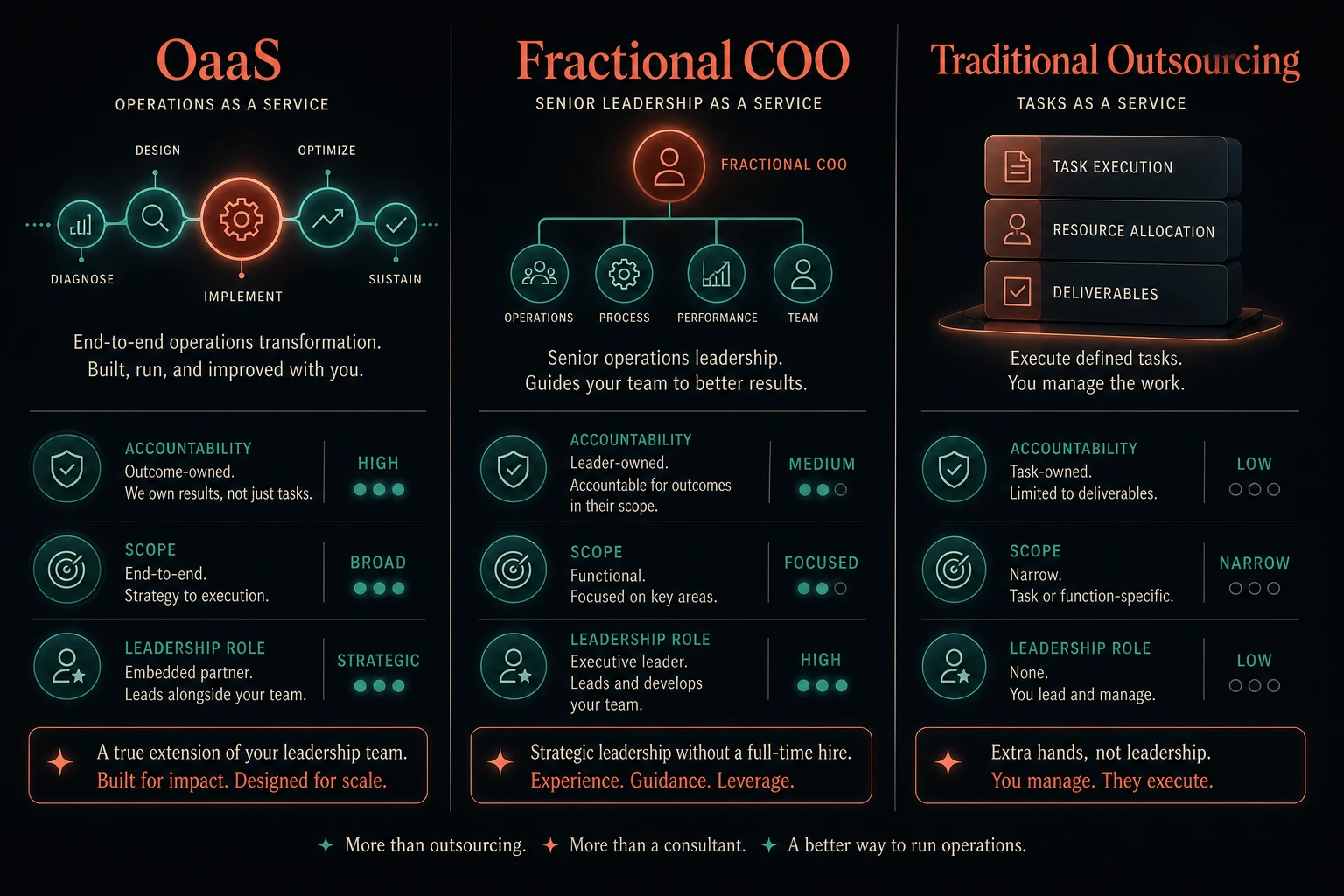
Operations as a service (OaaS) is a recurring engagement model in which an external provider designs, documents, automates, and manages defined operational functions on behalf of a startup, delivering specific outputs against agreed service levels rather than occupying an internal leadership role. It is distinct from hiring a fractional COO, who holds genuine executive authority inside the company, and from traditional outsourcing, which transfers labour-intensive tasks at lower cost through headcount. To understand what operations means inside a tech startup, it helps to see it as the connective tissue between strategy and delivery, which is exactly what OaaS is designed to strengthen.
How OaaS Differs from Hiring a Fractional COO
A fractional COO is a part-time executive who reports to the CEO, participates in leadership decisions, and manages internal teams. A fractional COO is not a consultant in the traditional sense. They hold genuine executive authority, participate in leadership and board-level conversations, and are accountable for outcomes across the business. They are embedded in the organisation, not advising from the outside. OaaS providers, by contrast, operate externally. They own specific process outputs, not internal team management. The accountability is to a service agreement, not to the org chart.
The practical difference matters most at the seed stage. A fractional COO is the right call when you need someone to own strategic operational decisions and manage the people doing the work. OaaS is the right call when you need documented, automated, and scalable processes without adding a senior leadership hire to your burn rate.
The Three Delivery Models
- Embedded OaaS: A dedicated operator works inside your existing team cadences, attending standups and coordinating directly with department leads. Best suited for seed-stage companies where process ownership needs to sit close to the product.
- Advisory OaaS: The provider audits current workflows, designs the operating model, and hands documentation to your team for implementation. Best suited for early Series A companies that have internal operators but lack operational architecture.
- Fully Managed OaaS: The provider runs defined operational functions end-to-end, including automation maintenance and reporting. Best suited for B2B SaaS startups scaling delivery volume faster than they can hire.
The 10-to-30 Employee Breaking Point: Why Startup Ops Collapse at This Stage
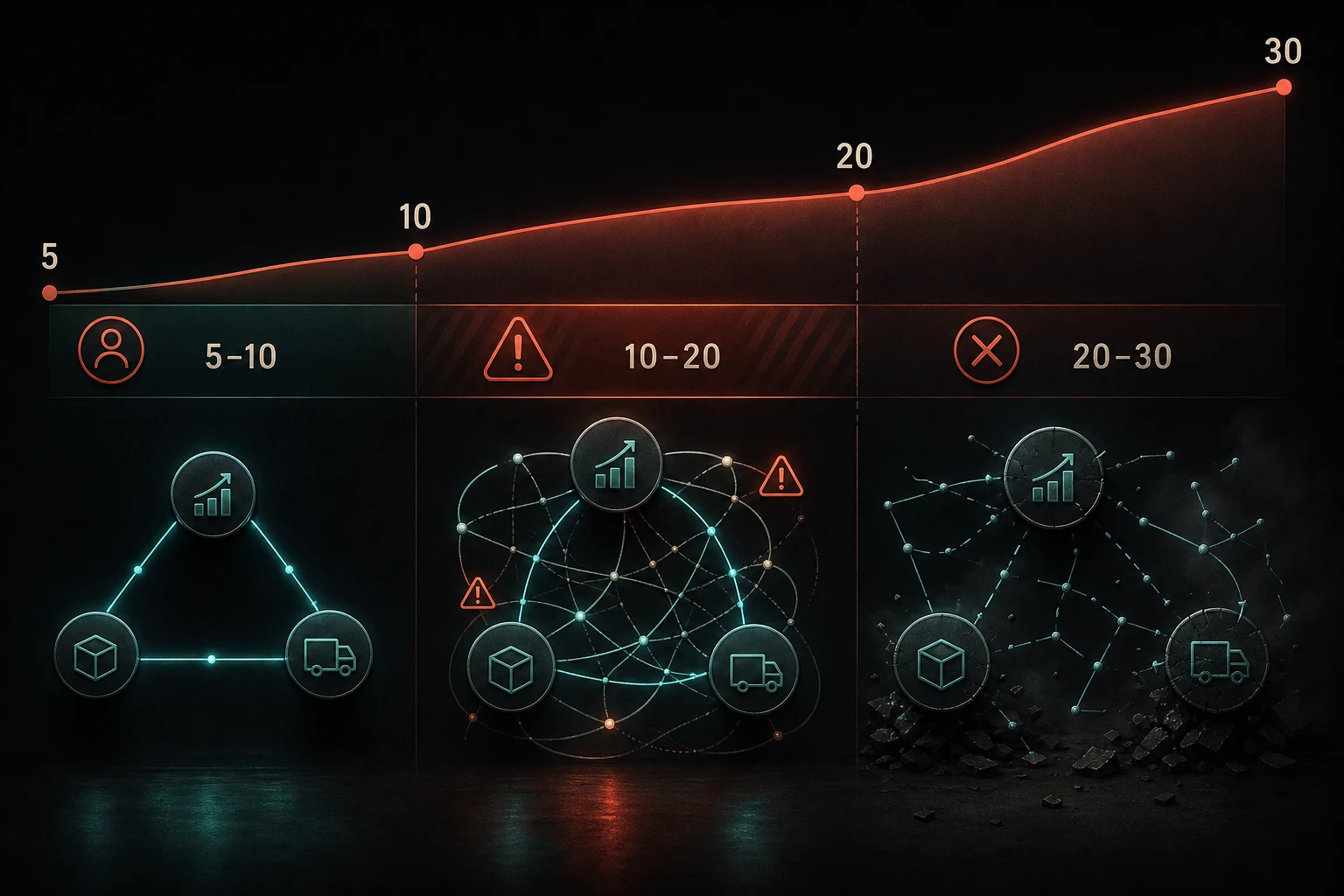
After five years, only 49.2% of businesses are still operating, according to SBA data, and a significant share of those failures trace back not to product-market fit but to operational breakdown during the growth phase. The structural reason is consistent across companies: at ten people, informal alignment starts failing, side conversations replace shared understanding, and the founder becomes the only connective tissue. At thirty people, departments begin forming, communication silos emerge, and cross-functional work requires deliberate coordination for the first time.
According to recent enterprise research on operational scaling, the operational mechanism is specific. What we consistently see is that the failure does not announce itself as an operations problem. It shows up as a customer delivery that slips, a sales handoff that loses context, or a product sprint that gets blocked by a process no one owns. By the time those symptoms surface repeatedly, the cost of rework has already compounded.
"The systems that carried your business to ten people stop working at twenty. Not because they were poorly designed, but because the communication thresholds that make informal alignment possible have been crossed." — Pattern observed across early-stage company scaling research and client engagements
Five Common Operational Failure Modes at This Stage
- Tribal knowledge concentration: Critical process knowledge lives in one person's head. When that person is pulled to a new priority, delivery stalls.
- Unstructured sales-to-delivery handoffs: Sales closes a deal with assumptions that delivery never receives in writing. The customer experiences the gap, not the teams.
- No source of truth for process: Processes that worked for ten people do not scale to thirty. Bottlenecks in hiring, onboarding, and decision-making start to appear. Many founders resist formalising processes to avoid bureaucracy, but the absence of structure creates chaos.
- Founder as the sole decision node: Every cross-functional question escalates upward because no one else has the context or authority to resolve it, bottlenecking the entire organisation.
- Tool sprawl without workflow design: Teams adopt tools individually to solve local problems, creating integrations that conflict and data that cannot be trusted.
Self-Assessment: Signals Your Startup Has Outgrown Founder-Led Ops
- The same process question gets asked by more than two different team members in a week.
- A new hire takes more than three weeks to become independently productive because no onboarding documentation exists.
- You can name a specific person whose absence would stop a core operational process from running.
- Customer delivery timelines are based on estimates in someone's head, not a tracked, documented workflow.
What Should Operations as a Service Actually Cover for Your Startup?
Most OaaS providers list process mapping, tooling, and reporting on their sales pages. What they rarely disclose is what sits just outside that scope. Understanding the boundary before you sign is the single most important due-diligence step in any OaaS evaluation. The table below separates what reputable providers typically include from what is commonly excluded.
Process Mapping — Typically Included: Current-state audit, future-state design, documentation · Typically Excluded: Team adoption, ongoing maintenance
Workflow Automation — Typically Included: Automation build for defined workflows · Typically Excluded: Tool licensing costs, custom integrations
Tooling Recommendations — Typically Included: Stack audit, tool selection framework · Typically Excluded: Vendor negotiation, implementation support
Reporting and Dashboards — Typically Included: KPI definition, dashboard setup · Typically Excluded: Data cleaning, ongoing data governance
Change Management — Typically Included: Rarely included by default · Typically Excluded: Team training, internal communications, resistance handling
People Operations — Typically Included: Process design for hiring and onboarding · Typically Excluded: HR strategy, compensation design
Watch Out: Many OaaS providers deliver polished documentation and process maps but define success as the handover of those deliverables, not whether your team actually uses them. Ask any prospective partner: "How do you measure success ninety days after you hand over process documentation?" A vague answer is a red flag.
How AI Workflow Automation Changes the Equation
The cost and capability ceiling of OaaS has shifted materially as AI-powered workflow automation has matured. Research on AI in operations shows that providers now employ advanced software, automation, and artificial intelligence to improve operational efficiency, allowing companies to take advantage of innovations without the hassle of direct implementation. For a startup, this means that an OaaS engagement can now automate recurring operational tasks, such as onboarding sequences, handoff notifications, and reporting pipelines, that previously required dedicated headcount to run.
The practical implication is that an OaaS provider who uses AI workflow automation as a delivery mechanism can compress the timeline from process design to operational output significantly. Explore how AI workflow automation for growing teams can be built directly into an OaaS engagement to reduce both the cost and the ramp time of your operations function.
How to Evaluate and Choose an Operations as a Service Partner
Most advice on choosing an OaaS partner stops at "check references and look for relevant experience." That is a necessary floor, not a useful framework. The mistake most teams make here is evaluating providers on the quality of their proposal decks rather than on the operational outcomes they have actually produced for comparable companies. The two are not correlated.
Outcome orientation — What to Look For: Provider defines success as measurable operational change, not deliverable volume · Red Flag: Proposal lists documents and workshops as the primary outputs
Startup stage fit — What to Look For: Provider has worked with companies at your headcount and funding stage · Red Flag: All case studies reference enterprise or post-Series B companies
Automation capability — What to Look For: Provider builds automation as part of the engagement, not as an add-on · Red Flag: Automation is listed as a future phase requiring separate scoping
Scope transparency — What to Look For: Explicit out-of-scope list in the contract, not just a scope-in list · Red Flag: Contract defines only what is included, leaving exclusions ambiguous
Adoption support — What to Look For: Provider includes team enablement and a defined handover period · Red Flag: Engagement ends at process documentation delivery with no follow-on
Questions to Ask Before Signing
- On outcomes: Can you show me a specific example where your engagement changed an operational metric, and what was that metric at the start versus at engagement close?
- On exclusions: What is explicitly out of scope for this engagement, and what happens if we need that work done mid-engagement?
- On adoption: What percentage of the process documentation you deliver is still actively in use by clients six months after engagement close?
- On team fit: Who specifically will be working on our account day-to-day, and what is their hands-on startup experience?
Pro Tip: Request a scoping call that includes your day-to-day operator, not just the partner or sales lead. The quality of questions they ask about your current workflows tells you more about their operational depth than any case study will.
Explore how industry leaders structure operational automation and digital transformation to understand how modern operations partners approach scope and delivery at scale.
OaaS vs. In-House Hire: A Realistic Cost and Capability Comparison
Every competitor article addresses this decision qualitatively. None of them quantify it. Here is a grounded cost model based on available data so you can make this decision with numbers, not impressions.
The cost of a full-time COO runs well past $250,000 once you add base salary, bonus, benefits, and equity. That figure does not include the three-to-six month recruiting cycle or the ramp time before a new executive is productive. At seed stage, that equity allocation is often the more painful cost. The cost of a fractional COO is driven by how many hours per day your business needs. Most fractional COOs charge between $150 and $375 per hour, depending on skillset and track record. An OaaS engagement with automation capability typically runs on a fixed monthly retainer model. Visit the relevant provider's website for current pricing specific to your engagement scope.
Full-Time Ops Hire (Senior) — Seed Stage Cost Indicator: $120K-$160K salary + benefits + equity · Series A Cost Indicator: $160K-$220K salary + benefits + equity · Equity Risk: High (0.5-2%) · Ramp Time: 60-90 days
Fractional COO — Seed Stage Cost Indicator: $6K-$15K/month retainer · Series A Cost Indicator: $10K-$20K/month retainer · Equity Risk: None to minimal · Ramp Time: 2-4 weeks
OaaS (Advisory/Managed) — Seed Stage Cost Indicator: Fixed scope retainer, visit provider for pricing · Series A Cost Indicator: Fixed scope retainer, visit provider for pricing · Equity Risk: None · Ramp Time: 1-2 weeks
When OaaS Is the Smarter Financial Choice
- Pre-product-market fit: You need operational structure to support sales and delivery, but your processes will change significantly in the next six months. A fixed hire locks you into a cost structure for a process that may not exist in its current form.
- Pre-Series A fundraising: Investors expect operational maturity evidence. An OaaS engagement can build that infrastructure faster and at lower cost than recruiting and ramping an internal hire.
- Runway is under eighteen months: Adding a senior salary to your burn rate when runway is constrained is a structural risk. OaaS scales down as engagement scope reduces.
When In-House Hiring Is the Right Call
- Post-Series A with defined processes: Once your operational model is documented and stable, an internal hire can own execution and iteration without needing to design from scratch.
- People management is the core need: If the primary gap is managing a growing internal team rather than designing processes, a full-time operations leader is the correct tool.
Hybrid Models
In practice, the most operationally mature early-stage startups combine both. An OaaS provider designs and automates the operational architecture; a lean internal operator owns day-to-day execution within that structure. Analysis of how companies are adopting AI for operations shows that this hybrid model—where external expertise handles architecture and internal teams execute—is increasingly common among growth-stage startups. A consultant may diagnose problems, while a fractional COO builds the solutions into day-to-day operations. The same logic applies to OaaS. The provider architects the system; your internal team runs it.
Frequently Asked Questions
What does operations as a service actually include for a startup?
OaaS typically includes process mapping and documentation, workflow automation build, tooling stack design, and operational reporting setup. What it most commonly excludes is change management, team training, tool licensing, and custom data integrations. The scope boundary varies significantly by provider, so requesting an explicit out-of-scope list before signing is essential. Providers who cannot clearly state what they do not cover are a procurement risk.
What is the difference between a fractional COO and operations as a service?
A fractional COO is a part-time internal executive who holds authority over teams, participates in leadership decisions, and is accountable for strategic operational outcomes inside your organisation. OaaS is an external engagement model where a provider owns specific process outputs defined in a service agreement. The fractional COO manages people and holds a seat at the leadership table. The OaaS provider designs and automates processes and operates externally to your org chart. The right choice depends on whether your primary gap is strategic leadership or operational infrastructure.
When should a startup outsource its operations instead of hiring in-house?
Outsourcing operations makes the stronger financial case when your runway is under eighteen months, your processes are still evolving rapidly, or you need operational infrastructure in place before a fundraising round but cannot absorb the ramp time of a senior hire. Once your operational model is stable and the primary need is managing people within a defined structure, an in-house hire delivers better continuity. The two are not mutually exclusive: a hybrid model, where OaaS designs the architecture and a lean internal operator runs it, is often the optimal path between seed and Series A.
The Right Operational Model Is a Structural Decision, Not a Budget Decision
Choosing between operations as a service, a fractional COO, and an in-house hire is not primarily about what you can afford. It is about which model matches your current operational gap, your headcount stage, and how rapidly your processes are likely to evolve over the next twelve months. Founders who make this decision based on cost alone routinely end up with the wrong structure at the exact stage where operational clarity has the highest leverage.
If your startup is approaching or inside the ten-to-thirty employee window and your operational processes are still founder-led, the time to act is before the compounding failure modes become visible to your customers or your investors. The earlier you design operational infrastructure with the right partner, the lower the cost of getting it right.
See how withSoch builds AI-powered workflows for startup ops teams and assess whether an OaaS engagement fits your current stage and growth trajectory.